













For those following the European Commission’s (the Commission) public statements on its 2030 consumer agenda one thing has become clear: Preparing a proposal for a Digital Fairness Act (DFA) remains a key priority on the Commission’s to-do-list despite all ongoing simplification efforts for the EU’s digital rulebook.
Following its 2024 Digital Fairness Fitness Check – which concluded that existing rules do not fully address harmful online practices in the digital sphere – the Commission has been working on a proposed DFA. The initiative is expected to tackle inter alia dark patterns, addictive design, unfair personalisation and influencer marketing. The impact assessment is ongoing, with a legislative proposal pencilled in for late 2026.
Between 17 July 2025 and 24 October 2025, the Commission conducted a public consultation and call for evidence generating 4,324 valid feedback submissions. Over 90 per cent of these submissions were filed by citizens with the remaining approx. 10 per cent being submissions from business associations, companies, public authorities, academic/research institutions, consumer organizations.
While the Commission is currently finalising its synopsis report (expected to be published this Friday, 19 December 2025), we conducted our own analysis of key stakeholder submissions and looked closer at what key players are asking for – and what that might signal for the shape of the DFA.
Methodology: How we read the consultation
Our analysis focused on 47 “key stakeholders” across five groups:
- industry associations and national business umbrella bodies;
- individual companies across digital and consumer-facing sectors;
- consumer and civil society organisations;
- academia and research institutions;
- public authorities and regulators.
Stakeholders were selected based on their influence in Brussels, track record in shaping EU policy debates and likely exposure to the DFA. The two groups that submitted most feedback are also represented strongest within our selected key stakeholders: Industry associations and companies, who will likely be both most affected and best placed to provide practical insights on the DFA’s impact on business practices, market operations, and investment decisions. Considering other groups such as consumer/civil society organisations and academia balances the discussion. Supported by Freshfields advanced AI solutions and using a common set of “theses” derived from recurring arguments in the submissions, we assessed, for each stakeholder and then each group, the relative agreement or disagreement with propositions taken from main arguments.
Who supports the DFA and who opposes it?
It is no surprise that stakeholders’ views diverge on the prospect of a potential DFA. As the below overview indicates, the strongest supporters of the proposal are consumer and civil society organisations. On the contrary, representatives of the private sector mostly oppose a potential DFA or at least recommend significant changes compared to the initial concepts following the Digital Fairness Fitness Check.
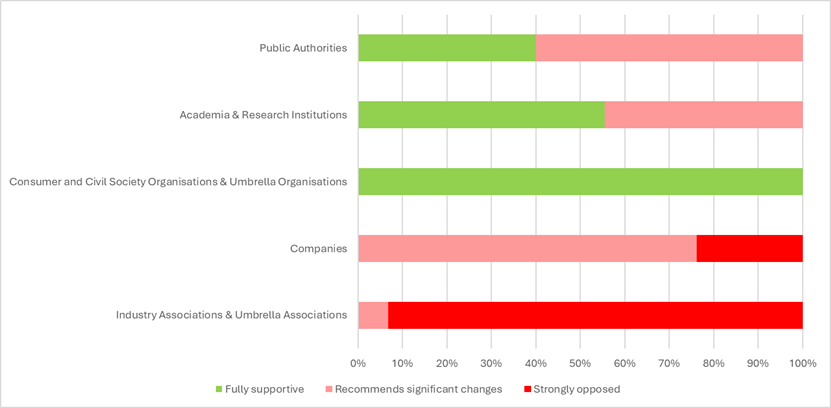 Overall support for a DFA among key stakeholder groups
- Industry associations: enforcement first, no sweeping new regime
Industry associations and national umbrella bodies are, as a group, the most sceptical of a horizontal DFA. A prevailing view is that existing EU law already provides the necessary tools, and that the priority should be consistent enforcement, guidance and simplification. Strongest consensus in this group pertains the view that a sweeping DFA is not needed as existing law largely suffices and enforcement and guidance should be prioritised over new rules that would risk overlap, complexity and fragmentation.
- Companies: Avoid duplication
Individual companies – across platforms, digital content, mobility, retail and other B2C sectors – are also cautious. They stress the value of existing EU consumer protection frameworks and emphasize the need to simplify and harmonize regulation rather than introducing new, potentially overlapping laws. Divergence emerges mainly around the level of prescriptiveness in areas such as cancellation flows, default user interface requirements, and the calibration of new obligations in sectors like gaming and streaming.
Academics: Mind the regulatory complexity and disproportionate burdens on SMEs when closing “fairness” gaps
Also academia / research institutions provided some critical feedback: While there is broad support for the core idea of the DFA closing “fairness” gaps in a targeted, evidence-based way, there are also recurring warnings about regulatory complexity, overlaps with existing rules, and disproportionate burdens on SMEs and innovation.
- Public authorities and regulators: Close gaps but keep it coherent
Public authorities and regulators have taken a very similar position: Although there is broad support for the policy goals behind the DFA across the submissions reviewed in this category (tackling manipulative design, protecting minors, addressing abusive personalisation and video‑game monetisation, and strengthening enforcement with clearer powers and better cross-border coordination), they argue that the DFA should build on and fill gaps in existing instruments while avoiding legal uncertainty that could arise from uncoordinated new rules.
- Consumer and civil society organizations: Urgent need for a DFA
Finally, consumer and civil society organisations are in favour of a potential DFA. They show robust, mainstream support for the DFA’s core regulatory ambitions seeing an urgent need for clear, operational definitions, comprehensive protection of vulnerable groups (especially minors), prohibitions on dark patterns and manipulative design, enhanced enforcement, and harmonisation with existing EU laws .
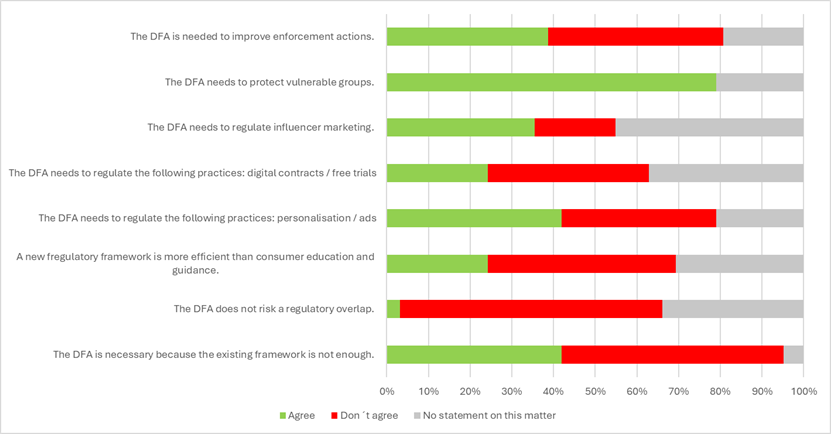 Controversy of the main theses
What this means for businesses
While there is a lot of disagreement, there is notable convergence on the need to protect minors, and to equip authorities with more effective enforcement tools. Accordingly, even before the Commission publishes its synopsis – and well ahead of any legislative proposal – a few themes can already be expected very likely under the DFA:
- Expect enforcement of existing rules to intensify: Many stakeholders – including those most sceptical of a new DFA – call for more consistent enforcement and joint guidance under the UCPD, CRD, DSA, DMA, GDPR and sectoral regimes. Companies should anticipate greater scrutiny of interface design, subscription journeys, pricing transparency and personalisation under the current toolkit. To get an overview of the current legal framework and how it already regulates practices criticized in the Digital Fairness Fitness Check, you can also check the Freshfields EU Digital Fairness Dashboard (request access here).
- Map and stress‑test your design choices: Dark patterns and manipulative design are heavily discussed to be (further) regulated. Businesses should identify where choice architectures, nudges, defaults or engagement features might be perceived as unduly steering users – particularly minors and vulnerable consumers – and consider design alternatives.
- Plan for a child‑ and vulnerability‑focused lens: Stakeholders across all groups emphasise protection of minors and vulnerable groups as a central objective. This is likely to inform both enforcement priorities under existing law and the calibration of any future DFA rules.
For a wider discussion of how these themes fit into the broader EU digital rulebook – including the DSA’s approach to dark patterns and design duties – see earlier posts in our EU digital fairness series.
What’s next
While the public consultation on the DFA is over, the discussion about the DFA isn’t and interested stakeholders should closely monitor further developments – it is never too late to make your voice heard. The Commission’s report on the DFA consultation is expected by 19 December 2025. We will continue to track these developments and their practical implications for digital businesses.